
Precision Parts Identification for the Cessna Citation CJ4
Keep your aircraft operating at peak performance with the Cessna Model 525C Illustrated Parts Catalog, designed specifically for the Cessna Citation CJ4. This comprehensive IPC delivers crystal-clear exploded diagrams, detailed part numbers, and structured assembly breakdowns that eliminate guesswork.
Every page supports accurate parts identification. As a result, you reduce downtime and prevent costly ordering errors. Moreover, technicians can quickly cross-reference components across airframe sections, systems, and structural assemblies. The catalog organizes information logically, which improves workflow efficiency during inspections and repairs.
Because business jets demand precision, this illustrated parts catalog ensures you never compromise on accuracy. Whether you manage a fleet or maintain a single aircraft, this manual empowers you with reliable, manufacturer-specific information. Consequently, you maintain compliance while protecting the long-term value of your aircraft.
Streamlined Maintenance, Repair & Overhaul Efficiency
Time matters in aviation. Therefore, this Cessna 525C parts catalog helps maintenance teams act fast and with confidence. The manual covers airframe structures, landing gear systems, powerplant installations, hydraulic components, electrical systems, and interior assemblies. Each section features detailed exploded views, making component identification fast and intuitive.
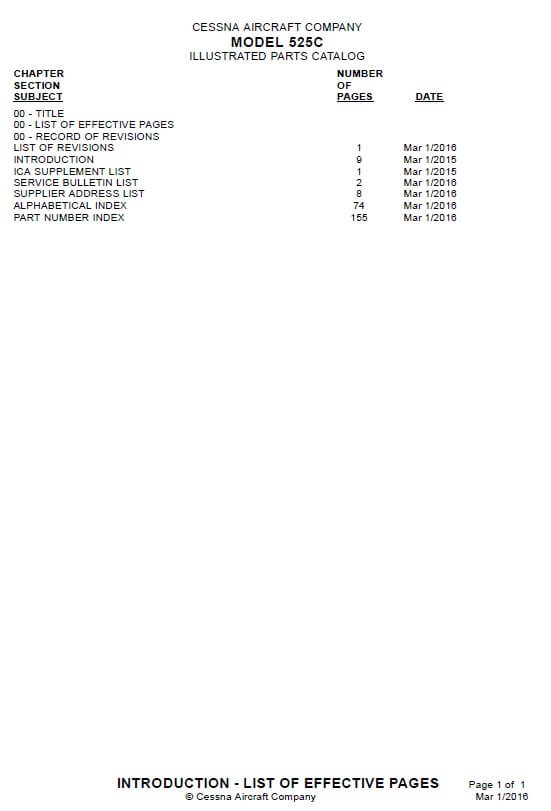
In addition, clear indexing and structured chapter divisions simplify navigation. Technicians can locate required parts in minutes instead of hours. That efficiency directly lowers aircraft-on-ground time and boosts operational readiness.
Furthermore, accurate part number listings reduce ordering delays. You avoid incompatible components and eliminate unnecessary returns. As a result, procurement teams operate more efficiently and control inventory better.
Because this catalog aligns with OEM documentation standards, it supports regulatory compliance and audit preparation. Maintenance organizations, MRO facilities, and private operators all benefit from its structured, professional format. Ultimately, this manual becomes an essential tool in every serious aviation maintenance environment.
Detailed Illustrated Diagrams for Confident Ordering
Visual clarity drives confident decisions. That is why this illustrated parts catalog includes high-resolution diagrams that clearly map assemblies and sub assemblies. Each illustration connects directly to corresponding reference numbers and item descriptions.
Consequently, technicians can identify even small hardware components without confusion. From fasteners and brackets to major structural assemblies, every element appears in an organized visual format. This approach reduces interpretation errors and increases technical confidence.
Moreover, purchasing departments gain a competitive advantage. Accurate illustrations parts catalog allow teams to verify components before placing orders. Therefore, you avoid costly procurement mistakes and ensure faster turnaround times.
The catalog also supports long-term aircraft management. As your CJ4 ages, structured documentation becomes even more valuable. Detailed part tracking helps with lifecycle planning, component replacement scheduling, and resale preparation. In turn, you protect both operational reliability and asset value.
A Must-Have Technical Resource for Aviation Professionals
Serious aircraft owners and aviation professionals demand dependable documentation. This Cessna Model 525C Illustrated Parts Catalog delivers that dependability with clarity and precision.
Whether you perform scheduled inspections, troubleshoot systems, or manage inventory, this catalog strengthens every aspect of your operation. Additionally, it enhances communication between technicians, engineers, and suppliers. Everyone works from the same accurate reference source.
Investing in this manual means investing in safety, efficiency, and operational excellence. Because when every detail matters, the right documentation makes all the difference.


